The essentials at a glance:
- Collagen is the most abundant protein in the human body, accounting for 90% of skin collagen (1)
- Studies show: Hydrolyzed collagen can improve skin hydration and elasticity (2, 3)
- Vitamin C is indispensable for collagen synthesis – without vitamin C, the body cannot produce collagen (4)
- Various collagen sources: Marine (fish), bovine, porcine, chicken – each with its own characteristics (1)
- Kale, parsley, and citrus fruits are among the foods with a high vitamin C content
-
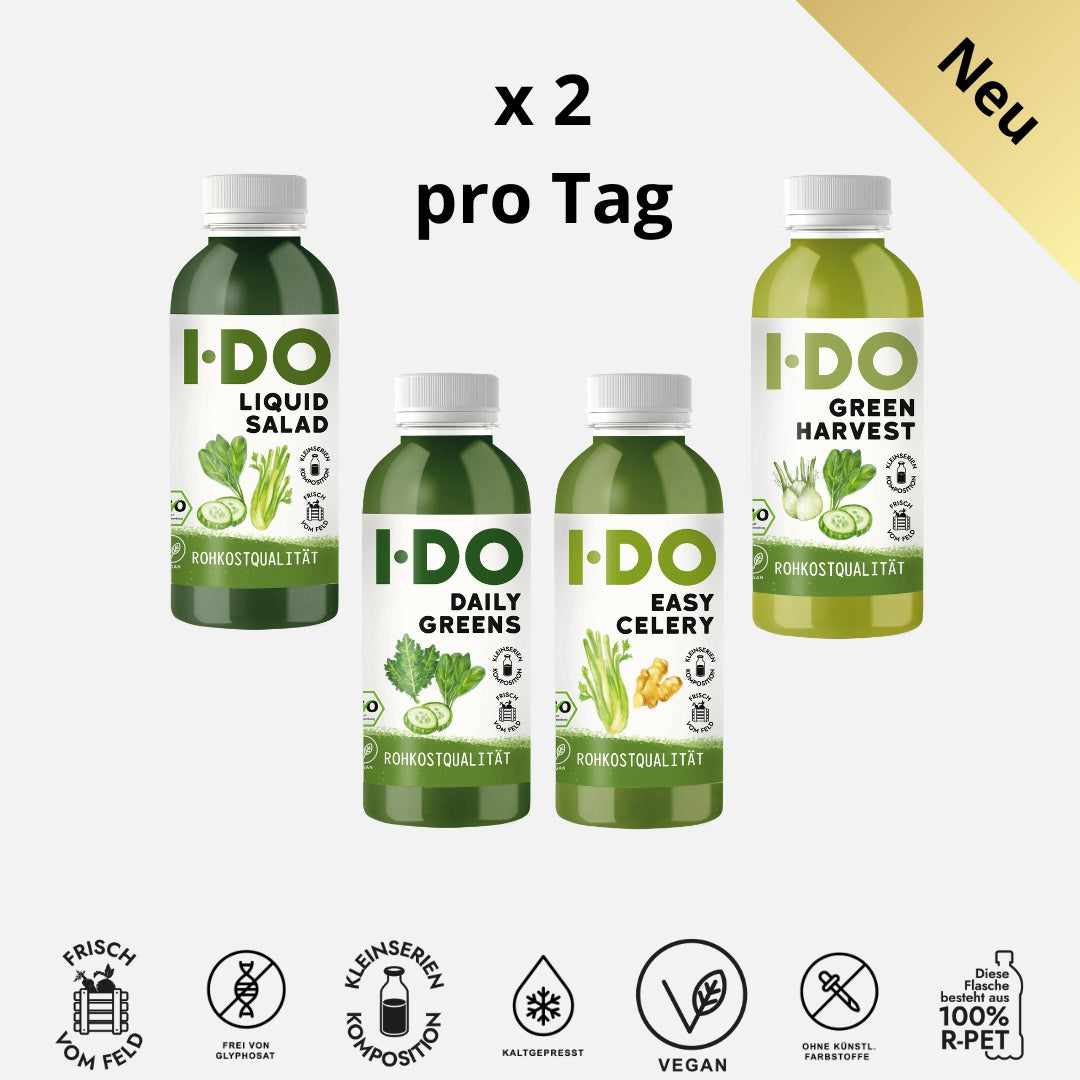
I·DO Bio raw juices such as Daily Greens and Sweet Greens combine a variety of fruits, vegetables, and superfoods to unite plant-based diversity in a single glass
What is collagen and why is it important?
Collagen is your body's structural protein – the "glue" that holds you together, so to speak. It forms the framework for skin, bones, tendons, ligaments, and cartilage. Incidentally, the word collagen comes from Greek: "kola" means glue and "gen" means to produce (1).
There are at least 28 different types of collagen, but three are dominant: Type I accounts for 90% of all body collagen and is found primarily in the skin and bones. Type II is found in cartilage, while Type III is in blood vessels and muscles. The less good news: the body's own collagen production decreases with age. From around age 25, the skin loses about 1% of its collagen every year. You notice this through wrinkles, decreasing elasticity, and slower wound healing (1).
Collagen sources: From fish to bovine – and the vegan alternative

Collagen can be obtained from various sources:
- Marine collagen (fish): Increasingly popular due to religious restrictions and BSE risks in cattle. Mainly Type I collagen, affordable and free of disease risk (1).
- Bovine collagen: Widely used, contains Types I and III. Studies show low immune reaction. Can serve as a precursor for blood-pressure-lowering peptides (1).
- Porcine collagen: Almost identical to human collagen, causes few allergic reactions. Types I and III (1).
- Chicken collagen: From breast cartilage, rich in Type II. Frequently used for joint health (1).
- Egg collagen: Another source is egg white collagen, obtained from the egg membrane. This source is becoming increasingly interesting for high-quality collagen products.
- Vegan alternative: Genuine collagen is always of animal origin. However, for vegans, there are collagen boosters – nutritional supplements with vitamin C, amino acids (such as glycine, proline), and other nutrients intended to boost the body's own collagen production. The research on this, however, is still sparse.
Collagen for skin and joints: The scientific findings
A major scientific review summarized the results of 26 different studies involving a total of 1,721 people. The result was clear: hydrolyzed collagen significantly improved both skin hydration and skin elasticity compared to a placebo (2). Another study from 2024 with 130 participants also showed improvements in skin, hair, and scalp after twelve weeks of daily intake of collagen with vitamin C (3).
Research also shows positive results for joint problems. A study on osteoarthritis found that Type II collagen from chicken cartilage could improve treatment. In a large multicenter study, osteoarthritis patients reported significantly fewer symptoms after 180 days, with better results than with the intake of glucosamine or chondroitin alone (1).
Why vitamin C is essential for collagen formation
Collagen cannot be formed without vitamin C – it’s as simple as that. Vitamin C has a critical task in collagen biosynthesis: it prevents two key enzymes (lysyl and prolyl hydroxylase) from stopping their work. Without these two enzymes, the body simply cannot build collagen (4).
A major review from 2018 investigated how vitamin C affects the body after injuries. The results were impressive. In cases of bone fractures, vitamin C accelerated healing in two different studies. With tendon injuries, vitamin C supplementation led to significantly more Type I collagen fibers. And in cases of cruciate ligament surgery, better graft integration was shown within the first six weeks (4).
What happens if there is too little vitamin C? Then there is a risk of scurvy – a disease that occurs when the body can no longer produce collagen. The consequences are bleeding gums, poor wound healing, and fragile blood vessels.
Which foods provide particularly high levels of vitamin C?

If you want to support your body in collagen formation, it is worth looking at vitamin C-rich foods. Here is an overview of the leaders, measured in milligrams per 100 grams:
- Acerola: 1,500–2,000 mg (one of the richest natural vitamin C sources)
- Parsley: 133 mg
- Bell pepper: 140 mg
- Kale: 120 mg
- Broccoli: 95 mg
- Lemon juice: 53 mg
- Spinach: 50 mg
For comparison: the daily requirement for adults is about 95–110 mg – which corresponds to roughly two medium-sized bell peppers or a large portion of kale.
A practical way to get several of these vitamin C-rich ingredients at once is through cold-pressed juices. They combine various vegetables and fruits that naturally contain vitamin C.

- Our Fireball Reset combines acerola (the leader on our vitamin C list) with pineapple, apple, passion fruit, ginger, and a pinch of cayenne pepper.
- Our Daily Greens brings, for example, kale and lemon juice together with apple, cucumber, and spinach.
- Green Harvest relies on the combination of parsley and lemon juice, supplemented by cucumber, fennel, spinach, and basil.
- And Liquid Salad unites cucumber with apple, celery, spinach, spirulina, and lemon juice.
Discover our I·DO raw juices now and experience plant-based diversity in organic quality.
What you should know about collagen supplements
Research shows that hydrolyzed collagen is the most easily absorbed by the body. The reason: during hydrolysis, large collagen molecules are broken down into smaller peptides that the intestine can absorb much more easily (2, 3). This form is also referred to as collagen peptides or collagen hydrolysate.
In most studies, between 2.5 and 15 grams of hydrolyzed collagen were taken daily, often in combination with vitamin C. The duration of intake was usually eight to twelve weeks, with the first positive effects sometimes visible after as little as four weeks (2, 3).
It is important to understand: collagen supplements are not a miracle cure. They work best as part of an overall healthy lifestyle with sufficient sleep, a balanced diet, and conscious handling of sun exposure.
What you should look out for when taking it
In principle, collagen is considered safe and is well-tolerated by most people. In studies conducted so far, side effects have occurred only rarely (1, 2, 3). Nevertheless, there are a few points you should keep in mind.
People with allergies to fish, bovine products, or chicken should be particularly cautious and always check the source of the collagen. Anyone who is allergic to shellfish, for example, should avoid marine collagen (1).
With bovine collagen, there is theoretically a very low risk of prion transmission (BSE, "mad cow disease"). Marine collagen from fish is considered the safer alternative here, as no such risks are known (1).
If you are unsure or are already taking medication, it is best to have a quick word with your doctor before your first dose.
Conclusion: Collagen and vitamin C are a team
Research paints a clear picture: collagen plays a central role for our skin and joints. More than 1,700 people have shown in controlled studies that hydrolyzed collagen can actually have an effect – measurable in skin hydration and elasticity (2, 3).
The key point: vitamin C is not just a nice addition, but absolutely necessary. Without vitamin C, your body simply cannot produce collagen (4). That is why it makes sense to reach for foods like kale, parsley, bell peppers, and citrus fruits, or to combine them in the form of cold-pressed juices.
Whether collagen supplements make sense for you personally is an individual question. In any case, the scientific basis is promising, especially when it comes to skin health and joint issues. And remember: supplements work best as part of the big picture – together with good sleep, a balanced diet, and mindful care of your skin.
Sources
- Wang H. A Review of the Effects of Collagen Treatment in Clinical Studies. Polymers (Basel). 2021;13(22):3868. doi:10.3390/polym13223868
- Pu SY, Huang YL, Pu CM, Kang YN, Hoang KD, Chen KH, Chen C. Effects of Oral Collagen for Skin Anti-Aging: A Systematic Review and Meta-Analysis. Nutrients. 2023;15(9):2080. doi:10.3390/nu15092080
- Reilly DM, Lear D, Khoshnoodi L, Proudman E, Nourallah S. A Clinical Trial Shows Improvement in Skin Collagen, Hydration, Elasticity, Wrinkles, Scalp, and Hair Condition following 12-Week Oral Intake of a Supplement Containing Hydrolysed Collagen. Dermatol Res Pract. 2024;2024:8752787. doi:10.1155/2024/8752787
- DePhillipo NN, Aman ZS, Kennedy MI, Begley JP, Moatshe G, LaPrade RF. Efficacy of Vitamin C Supplementation on Collagen Synthesis and Oxidative Stress After Musculoskeletal Injuries: A Systematic Review. Orthop J Sports Med. 2018;6(10):2325967118804544. doi:10.1177/2325967118804544